

Key Takeaways
- 401(k) plans significantly boost individuals’ retirement savings.
- Features like automatic enrollment and escalation enhance saving behaviors.
- Recent legislative changes aim to make retirement savings more accessible.
The Role of 401(k) Plans in Retirement Savings
Employer-sponsored retirement savings programs have become fundamental to financial security in the United States.
By offering structured options such as a traditional or Roth 401(k), organizations give employees an accessible, tax-advantaged way to save for the future.
Enrolling in an employer-sponsored 401(k) plan is often the first step many workers take towards building lasting retirement wealth.
These plans encourage discipline and regular savings, making it easier to achieve retirement goals.
The influence of such plans cannot be overstated. Nearly half of American workers with 401(k) access say they likely would not save for retirement otherwise.
According to a recent survey by the Investment Company Institute, the structure and convenience of these plans increase participation rates and overall savings.
Simply providing a centralized way to withhold savings from each paycheck removes significant barriers to retirement readiness.
Another significant benefit comes from employer-matching contributions, in which companies match a percentage of employees’ deferrals.
This direct financial incentive further motivates workers to participate and maximize their contributions, enhancing the long-term growth of their retirement accounts.
Additionally, 401(k) plans often offer a streamlined selection of investment options and managed portfolios, reducing confusion and helping employees make informed decisions aligned with their age, risk tolerance, and retirement timeline.
Automatic Enrollment and Its Impact
Modern 401(k) plans often include features designed to boost participation. Chief among these is automatic enrollment.
Under this arrangement, employees are enrolled by default and must actively opt out if they do not wish to participate.
The efficacy of automatic enrollment is well documented, as shown in a Vanguard report indicating that 76 percent of plans now allow immediate eligibility. In comparison,61 percent set the default deferral rate at 4 percent or higher.
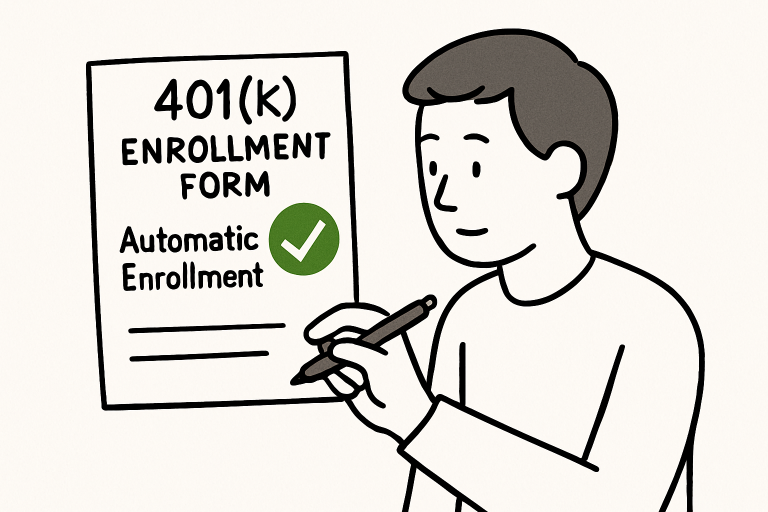
This use of default settings appeals directly to human behavior. People tend to stick with the status quo due to inertia or a desire to avoid complex financial decisions, so auto-enrollment ensures many do not miss out on the crucial early years of saving.
Over time, this inertia becomes a positive force that keeps participation rates high and augments individual savings habits.
Automatic Escalation: Encouraging Higher Contributions
Saving for retirement is not a one-time decision but a process that should evolve with a person’s career and earnings.
To encourage ongoing improvement in savings habits, many 401(k) plans now offer automatic escalation.
This feature typically increases employee deferral rates by one percentage point each year until a specified cap is reached, gently nudging participants to save more as their salaries increase.
Statistics from the Plan Sponsor Council of America reflect this positive trend. Today, 78 percent of companies with automatic enrollment also use automatic escalation, a marked rise from 65 percent in 2013.
The combination of auto-enrollment and automatic escalation takes the guesswork out of saving, paving the way for more robust retirement balances over time.
Legislative Enhancements: The SECURE 2.0 Act
Recent years have seen landmark legislative changes aimed at making retirement savings even more accessible.
The SECURE 2.0 Act stands out for adding flexibility and broadening the reach of workplace retirement plans.
Key features include raising the Required Minimum Distribution (RMD) age to 73, eventually increasing it to 75, and eliminating RMDs for Roth 401(k) accounts starting in 2024.
The Act also allows employers to match student loan repayments with retirement plan contributions, extending the benefits of a 401(k) to younger employees who are still paying off education debt.
By introducing over 90 updates, the SECURE 2.0 Act strives to remove obstacles and enhance lifelong participation in employer plans.
These changes are intended to reflect the modern workforce, making it easier for employees at every stage of their careers to save effectively for retirement.
Addressing Disparities in Savings
While 401(k) plans have made retirement saving more attainable, notable disparities remain in who benefits most.
A recent analysis by Vanguard found that the top 20 percent of income earners captured 44 percent of all employer plan contributions, even though they accounted for only 39 percent of earnings.
This disproportionate benefit suggests there is more work to do in encouraging lower-income employees to participate and in identifying plan features that might address their unique challenges.
Policymakers and employers must keep working to close these gaps, whether by improving financial education, boosting incentives for lower-wage workers, or removing administrative barriers that can deter participation among underserved groups.

The Psychological Aspect: Inertia and Savings Behavior
Behavioral economics has long suggested that people often stick with default choices, for better or worse.
By designing retirement plans that harness inertia, such as setting beneficial defaults for enrollment and annual contribution increases, employers help workers make sound long-term financial decisions.
According to the Center for Retirement Research at Boston College, these features drive higher savings rates and improve overall retirement preparedness.
Market Performance and Retirement Balances
Investment growth plays a crucial role in strengthening retirement savings and long-term financial stability.
When financial markets perform well, account values increase, giving investors greater confidence and encouraging higher participation and contribution rates.
Positive performance also reinforces disciplined saving habits and long-term planning strategies. In the first half of 2023, strong market conditions contributed to an average 401(k) balance of $112,400, reflecting a 4 percent increase from the prior quarter and more than 8 percent growth year-over-year. Such gains demonstrate how consistent market recovery can significantly enhance retirement portfolios over time.
Conclusion
401(k) plans have become an essential foundation for building retirement security in America.
Through mechanisms such as automatic enrollment, escalation, and legislative advancements, these plans have made it easier for employees to start and maintain healthy savings habits.
However, challenges remain in ensuring equitable access and outcomes for all workers. By leveraging behavioral science and continuously refining plan design, both employers and policymakers can help close these gaps, ensuring that every worker has the tools necessary for a financially secure retirement.
