
Most people don’t think twice about a drill press until they’re mid-project on a steel beam 20 feet off the ground, wishing they had the right tool. Choosing poorly here costs you time, money, and maybe a few choice words.
If you’re asking what to look for in a portable magnetic drill press, here’s the core of it: magnet strength, motor power, and drill capacity matter most.
But the gap between one model and another can genuinely change how your job goes. This guide walks through each factor so you can buy with real confidence.
Performance Specs That Actually Matter on the Job
Finding the right tools can make all the difference in your project. The portable magnetic drill press you choose needs to hold firm and cut clean.
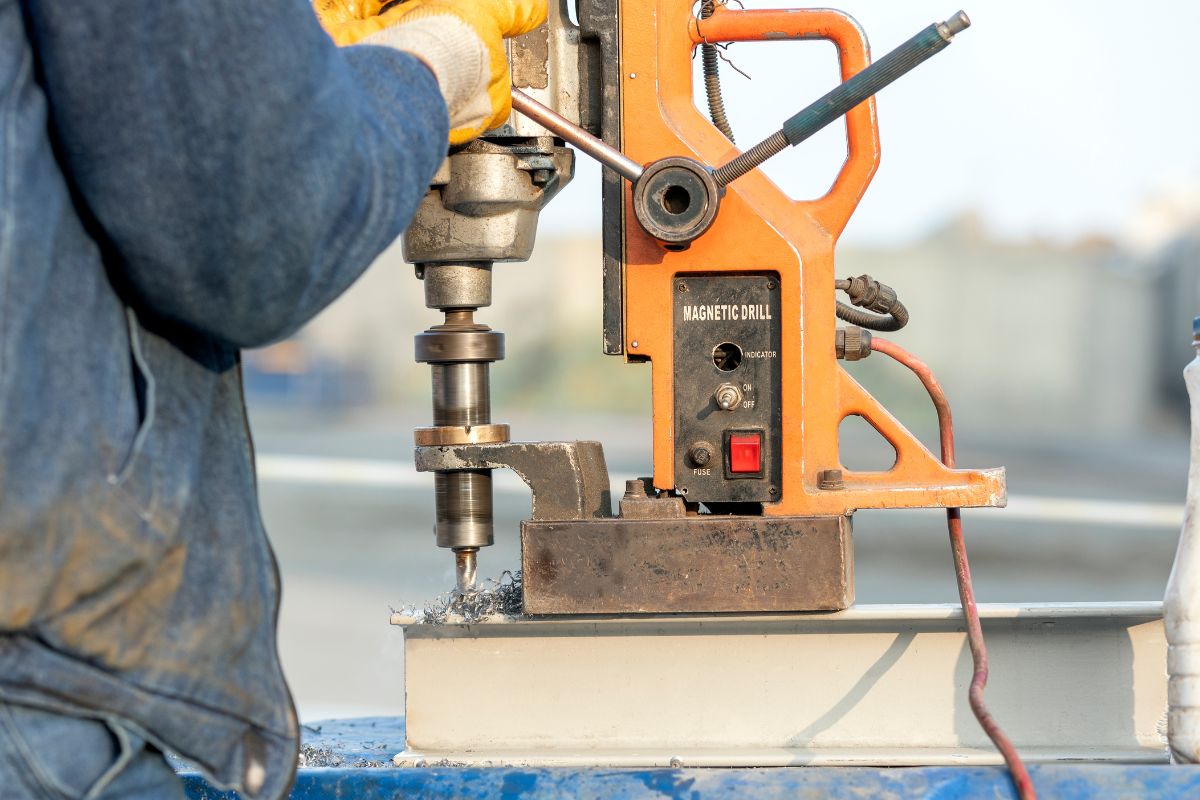
Understanding the key specs before you buy keeps you from expensive regrets. These numbers show you how a unit’ll perform when it counts.
Magnetic Holding Force: The Spec Most Buyers Overlook
Magnetic holding force comes in pounds or kilonewtons. It’s the single number that tells you whether the drill’ll stay put or shift mid-cut.
You want a minimum of 1,650 lbs of holding force (around 7.5 kN) for most structural steel work. Drop below that on vertical or overhead surfaces, and you’re gambling on slippage.
The base plate size matters too. Wider bases spread magnetic contact across more surface area, so a unit with 1,800 lbs of force and a larger footprint often outperforms a 2,200-lb unit with a smaller base when you’re working on uneven or painted steel.
Motor Power and Speed Range
A portable magnetic drill press motor typically runs 1,200W to 1,800W. Higher wattage handles larger annular cutters without bogging down, but it also adds weight. The sweet spot for most trades sits around 1,200W to 1,500W.
Variable speed? Worth paying for. Soft steel drills faster at higher RPMs; harder alloys need slower speeds to avoid burning the cutter. Look for a range of 130 to 620 RPM to cover most materials you’ll hit.
Drilling Capacity and Stroke Length
Maximum drilling diameter tells you the largest cutter the arbor accepts. Most mid-range units cap at 2 inches (51mm), which handles structural steel fabrication without breaking a sweat. Stroke length, often 60mm to 70mm, sets how deep a single plunge can go.
And don’t skip over the arbor type. Weldon Shank compatibility (typically 3/4-inch or 19mm) is standard across annular cutter brands, so match the arbor to your existing cutters before you buy.
Features That Separate a Good Unit from a Frustrating One
Raw specs get the unit onto your shortlist; features determine whether you’ll actually want to use it every day. A few extras save real time on busy job sites.
Built-in Safety Systems
A low-voltage release is essential. It cuts power to the electromagnet if the current drops, preventing the drill from releasing mid-cut if a generator malfunctions or a breaker trips. Some units throw in an LED indicator that shows magnet engagement status; on noisy sites, that’s gold.
An auto-shut-off feature that triggers when the base lifts off the workpiece adds another layer of protection. Not every model includes it, so check the spec sheet.
Depth Stop and Feed Handles
A depth stop lets you drill consistent holes across a batch of plates without measuring each one. On repetitive structural work, that’s a real timesaver.
Three-arm feed handles (instead of one or two) give you better torque control on large-diameter cuts, and they’re kinder on your hands over a long shift.
Hunt for a fine-depth adjustment knob if precision matters to your work. Some units only offer a rough-lock collar, which gets frustrating fast.
Weight, Handle Design, and Transport
Portability’s the whole point here. Most quality units land between 26 and 40 lbs. Under 30 lbs is genuinely easy to move around scaffolding; over 35 lbs, and you’ll feel it after a few hours.
Handle placement counts. A top carry handle plus a grip near the base lets you position the unit accurately on awkward surfaces; carry cases or storage bags protect the tool between jobs and show a brand that understands real-world use.
Conclusion
Buying a portable magnetic drill press comes down to three core things: enough magnetic holding force for your surface conditions, a motor rated for your cutter sizes, and safety features that protect the tool and the operator.
Weight and handle design determine how practical the unit is day-to-day afterward. Match specs to your actual work, not the heaviest-duty option on the shelf, and you’ll get a drill that earns its place in the truck.
